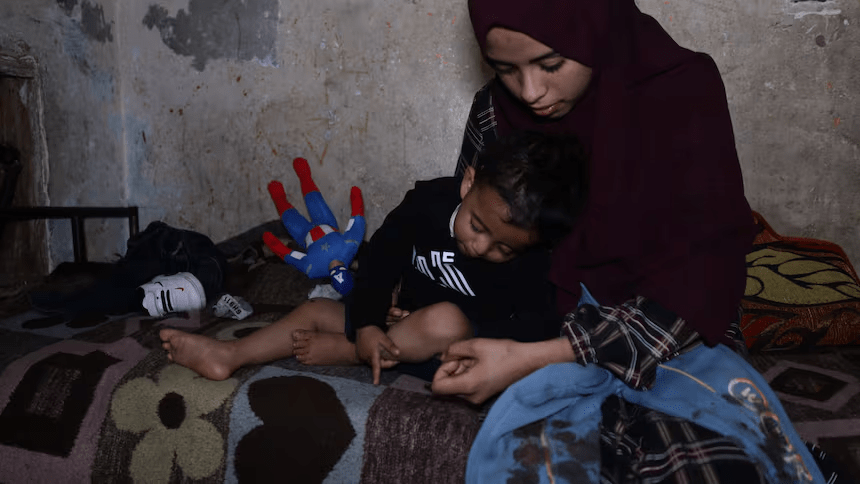
Eighteen-month-old Jawad Abu Nassar, seen here with his mother, Waad al-Shafi’i, was taken into Israeli custody with his father on March 19. He was released later that day to the International Committee of the Red Cross, but his father remains in custody. (Mohamed El Saife/CBC)
Gaza family says toddler released from Israeli custody found with cigarette burn marks | CBC News
On March 19, the day before Eid al-Fitr, Osama Abu Nassar took his 18-month-old son, Jawad, to a supermarket east of al-Maghazi refugee camp in central Gaza when eyewitnesses say he approached a restricted area and was detained by the Israeli military.
When Jawad was returned to his mother more than 10 hours later, he had injuries to his legs that looked like punctures and cigarette burns.
Waad al-Shafi’i, 29, said she had no knowledge of her husband and son’s condition from 10 a.m. until roughly 8:30 p.m. local time, when she was contacted by the International Committee of the Red Cross (ICRC) to pick Jawad up from al-Maghazi market, after Israeli forces handed him over to authorities.
Al-Shafi’i said that when she retrieved Jawad, he was wrapped in a thermal blanket, visibly shaken, with bloodstains across the lower half of his blue sweatpants.
“I felt like he was in pain, so I hugged him, but he couldn’t bear me holding him,” al-Shafi’i told a freelance videographer for CBC News.
“When I exposed his legs, I saw that they abused him. Here, there were cigarette burns. And over here, there’s an exit and entry [wound],” she said, pointing at round burn marks on his legs that matched the pattern of blood on the pants he was wearing that day.
His father remains in Israeli detention.
The Israel Defence Forces (IDF) rejected the allegations of abuse.
“The child received care and was under the full supervision of an IDF physician and additional troops until handed over to the Red Cross at the earliest opportunity,” the IDF said in a statement to CBC News on March 26. “The troops acted to ensure the toddler’s safety and provided the necessary medical attention.”
Injuries consistent with cigarette burns: doctor
The IDF released video of the moment they handed Jawad over to Red Cross officials.
“He’s stable, vitals are stable. He walked, jumped, he’s happy,” the soldier carrying Jawad can be heard telling the Red Cross member in the video.
Al-Shafi’i said Jawad could barely sleep that night, crying out yet recoiling from her touch. She said she gave him painkillers but the pain in his legs kept him and the family awake.
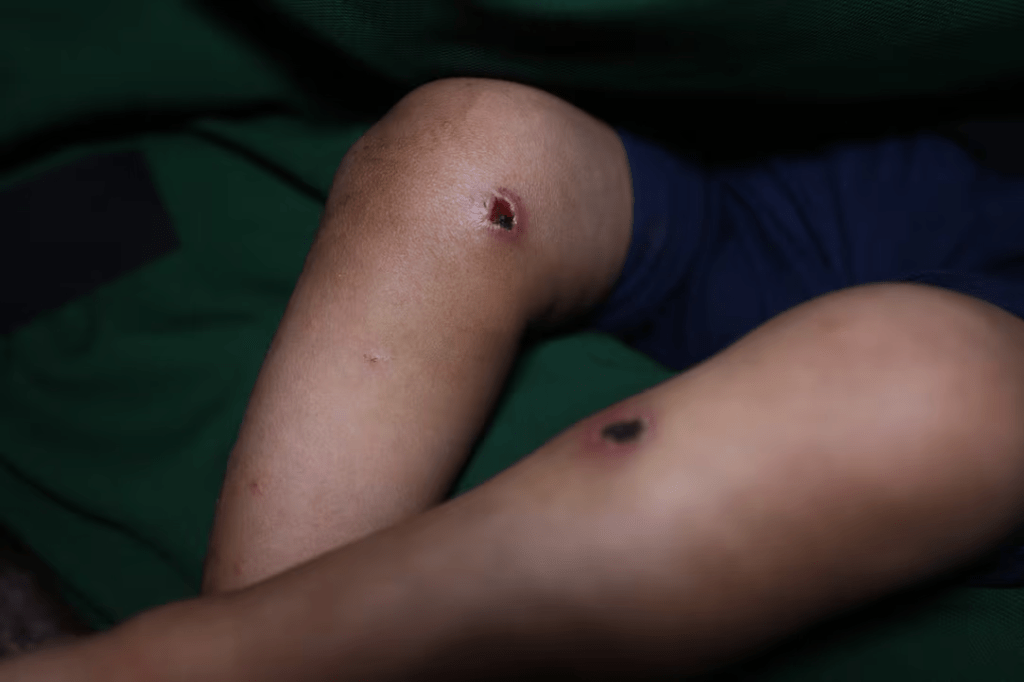
Dr. Bissan Ahmed at Al-Aqsa Hospital in Gaza says the round burn marks seen on Jawad Abu Nassar’s legs are consistent with cigarette burns. (Mohamed El Saife/CBC)
The next morning, al-Shafi’i took Jawad to Al-Aqsa Hospital in the Gaza city of Deir el-Balah, where doctors examined his wounds. Dr. Bissan Ahmed said Jawad cried loudly and was very reactive when she attempted to conduct a physical examination.
“There were multiple separate circular, sunken and regularly punctured marks that perfectly matched the effects of extinguishing cigarettes on the body,” Ahmed told CBC News. “These are deep second-degree burns that cause tissue damage that may reach the nerves and cause severe pain.”
- Israeli military drops charges against soldiers accused of sexual, physical abuse of Palestinian detainee
- Forensic experts in Gaza say bodies of Palestinians released by Israel show signs of torture
Al-Shafi’i said her son was examined by multiple doctors who determined that the wounds on his legs were “from torture, not shrapnel or bullet wounds.”
Doctors also found multiple puncture wounds on his legs they said were likely caused by a nail, according to a medical report seen by CBC News.
Ahmed added that in addition to physical signs of abuse, Jawad exhibited severe anxiety, appearing to be in “a state of panic and fear that occurs as a result of exposure to severe psychological and physical trauma.”
Neighbours tried to stop father
The Red Cross helped facilitate Jawad’s release from the IDF and picked up Jawad from Kissufim crossing, which is located in the eastern part of the Gaza Strip, between Khan Younis and Deir al-Balah.
The organization could not comment on the child’s condition, due to privacy reasons.
Al-Shafi’i said that on the day he was detained, her husband was in psychological distress because his horse had died a couple of weeks earlier. It meant a loss of income, because Abu Nassar used the horse to transport bricks and other material. Al-Shafi’i said her husband also lamented the living conditions in Gaza, where much of the infrastructure has been destroyed during Israel’s assault on the territory.
On March 19, eyewitness Yahya Abu Awad, who lives in the area east of al-Maghazi camp, saw Abu Nassar and his son heading to the supermarket, roughly 50 to 70 metres from the barrier that demarcates the Yellow Line, which is a temporary boundary to separate Israeli- and Hamas-controlled areas of Gaza under the October 2025 ceasefire agreement.
Abu Awad said he was confused when he saw Abu Nassar suddenly turn the opposite direction to head east, to the Israeli side of the line.
“We tried to catch up to him but we couldn’t control him because of all of the gunfire … There was a lot of gunfire from the Israeli army. But he kept on walking,” Abu Awad said.
Neighbours who witnessed the incident from a tall building in the area said they saw a quadcopter drone get close to the father and son, ordering Abu Nassar to put the child down on the ground and expose his own stomach to the army to ensure he didn’t have any weapons strapped to him.
Abu Nassar was ordered to remove his clothes until he was in his briefs, before four soldiers came and detained him and his son.
The IDF said its troops were operating on the Israeli side of the Yellow Line when they identified a suspect approaching the line “while holding an unidentified object,” referring to his child, who witnesses said was on his shoulders at the time.
“Despite repeated calls to stop and move away, the suspect continued toward the forces, coming within a very short distance of several tens of meters. Consequently, warning fire was directed to the roadside to create distance from the area,” the IDF statement reads.
“The toddler was brought by a Hamas operative into a dangerous area to be used as a human shield,” the IDF statement alleged.
- Systematic violence, denial of medical care contributed to Palestinian deaths in Israeli custody: report
- ‘Like a nightmare’: Gaza doctor released after being detained in Israeli prisons for over 6 months
Doctor says injuries not from gunfire, residue
The military said the injuries seen on Jawad were likely “splinters” resulting from gunfire that hit both father and son.
When asked about the IDF’s claim that Jawad’s injuries could be the result of gunfire, Dr. Ahmed at Al-Aqsa Hospital said X-rays showed no foreign objects inside the child’s body as a result of weapon fire or gunpowder, ruling out any penetrating shrapnel or object as the cause of his wounds.
“The mechanism of action for these injuries is the direct exposure of a high-heat ignition source consistent with cigarette burns,” Ahmed said in a message to CBC News.
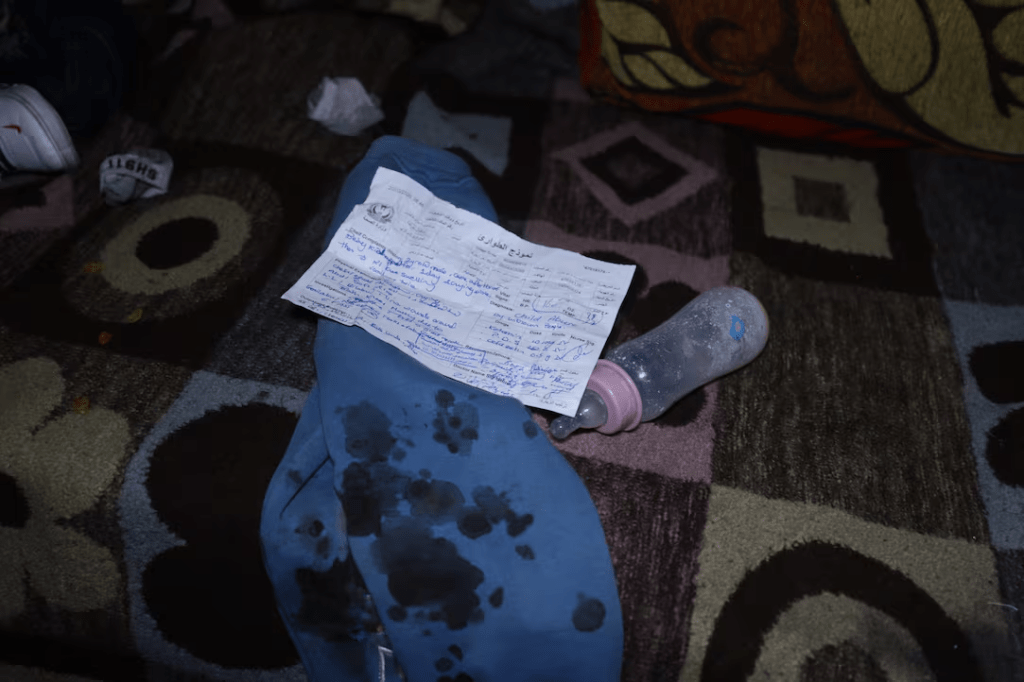
Jawad’s blue sweatpants were covered with bloodstains after he was released from Israeli custoday on March 19. A hospital examination report shows his diagnosis was ‘child abuse by unknown people.’ (Mohamed El Saife/CBC)
Israel’s two-year-long offensive campaign in the Gaza Strip has killed more than 72,000 Palestinians, most of them civilians, according to the territory’s health ministry. Since October 2025, when Israel and Hamas agreed to a U.S.-brokered ceasefire deal, at least 700 people have been killed, the ministry said. In that same time period, Israeli authorities said four of its soldiers were killed by militants in Gaza.
The IDF said Abu Nassar was taken by troops to a nearby military post where he reportedly received medical treatment and was questioned.
“During questioning, he identified himself as a Hamas operative and admitted entering Israeli territory during the October 7th massacre. He confessed to bringing his toddler son with him to prevent harm if he approached IDF troops,” the army said, adding that Jawad remained with his father at the military post except when he was questioned.
Osama’s father, Muhammad Abu Nassar, denied his son’s involvement with Hamas.
“My son has had no involvement with Hamas — not me, my son or anyone has had any involvement with Hamas, we all work as brick carriers and movers,” the 75-year-old said.
The family has no information on Osama’s condition, Al-Shafi’i said, and has been unable to get any details from authorities.
On Tuesday, Dr. Aliya Khan, co-chair of Doctors for Humanity, appeared at a news conference on Parliament Hill in Ottawa as part of a coalition of groups representing doctors and human rights activists in Canada. Speaking over Zoom, she called for “urgent and concrete” action from the federal government in light of the alleged abuse Jawad suffered under Israeli detention.
“Such heinous crimes and torture cannot be tolerated in a civilized world,” Khan said, calling on the government to demand an independent international inquiry into the torture of all Palestinians, particularly children.
ABOUT THE AUTHOR

Senior Writer
Sara Jabakhanji is a Toronto-based senior writer assigned to cover news developments in the Middle East. She has worked in CBC bureaus in Ottawa, London and Toronto.
********
Greencrow comments: As a former child protection social worker for the Government of British Columbia this story breaks my heart. Can you imagine the evil behind those cigarette burns on the child’s legs? That cowardly entity belongs in jail…not the distressed father who had a mental breakdown due to the death of his horse. His livelihood gone and his ability to feed his family.
He carried his child to the doorstep of his oppressors and they fired at him and his child. The father is now in custody. Nobody knows whether he is alive or dead. The child is forever scarred. Humanity is disgusting to allow this in our midst!
No wonder the Iranians are fighting so hard to prevent these entities from taking over their lands. What’s happening in Gaza is a blueprint for what they do everywhere they get control.

 Greencrow as the crow flies
Torture is a tool for the talmudists. Torturing a child so that the father will talk is common for them.
LikeLiked by 1 person
They likely tortured the child in front of the father. I doubt the father is alive. Hope I’m wrong but they’ve killed for much less.
LikeLike