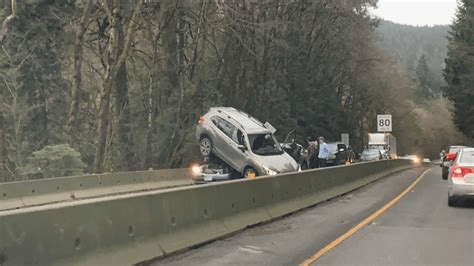
Good afternoon beloved sentients. Today I have a bonus feature for you about driving the most dangerous highway in Canada–the Malahat Highway on Vancouver Island.
Just this morning there was another serious accident on the Malihat also known as Highway 1.
Impaired driving suspected in serious morning crash on Highway 1 near Langford
There are accidents almost weekly on this twisting and winding highway perched on the mountainside overlooking the Strait of Georgia.
Let’s read the article recently posted in the local newspaper about driving the Malahat and I will have concluding comments thereafter.
Time to crack down on bad drivers on the Malahat – Victoria Times Colonist
It occurred to me that my last few columns became an unintended series of loosely connected thoughts about why people seem to choose to drive badly, why they ignore rules putting the rest of us in jeopardy, and what strategies are available to deal with bad drivers who might be in our lives.
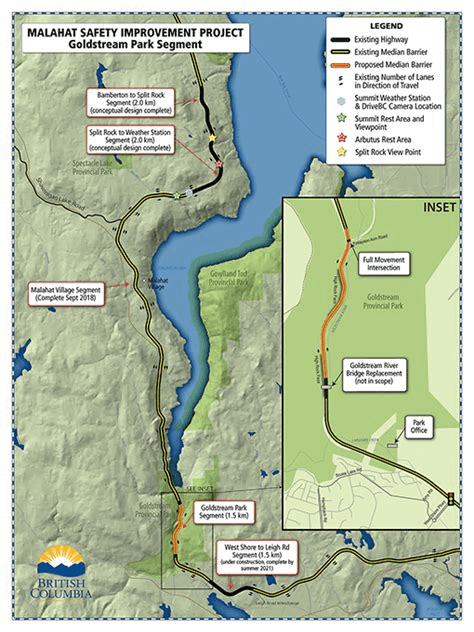
I had a case study in all of that presented to me when I had to drive up to Duncan last week, via the Malahat, of course. Regrettably, I had the displeasure of witnessing first-hand everything I have been writing about for the past 3 weeks — driving behaviour ranging from just plain irritating to that which basically bordered on being horrific. All that in one random 40-minute roadie in the late afternoon.
I try to consciously not be just a ranter about poor driving behaviour. Everyone has their own first-hand experiences. Why keep telling people what they already know? Then I received an email from Pam.
A long time reader, Pam has been driving for 60 years — everything from sports cars to big grain trucks and farm machinery. One of her opening email lines was: “I find myself having to drive the Malahat regularly and have come to dread it.” Amen.
Before we get to Pam, my own Malahat experience last week looked like this:
Eleven vehicles passed me in the 70 km/h zone, near Goldstream, doing anywhere between 85 and 100. Approaching the summit a small white compact toodled by in the fast lane at between 105 and 110 in the 80 km/h zone. He was probably doing that because of the brand new Ford Bronco — no more than 3 or 4 metres behind — bearing down on his rear bumper. Once the white car was “forced” into the slow lane, the Bronco engaged his afterburners, hitting somewhere between 125 to 130 km/h.
A Ford F-250, a fancy King Ranch version, cruised by seconds later, a little slower this time at 100 km/h or so — passenger smoking a joint and while the driver was on his cellphone, probably ordering some food to deal with the upcoming munchies.
The cherry on the cake though happened a few minutes earlier, back near the Goldstream entrance. A small blue compact was actually doing just under 70 in the 70 km/h zone, four-way flashers blinking.
My first thought was that this was an overly conscientious driver trying to do the right thing and set the example. Wrong again.
Passing by I saw that his left rear wheel hub assembly was nearly broken off. The wheel itself jutting out, and wobbling precariously, at a 45-degree angle. I mean what could go wrong if you lost an entire wheel while climbing the Malahat in heavy traffic?
Pam’s experiences are pretty similar, with large pickup trucks often being the “usual suspects.”
One time she tapped her brake to ask one of these brodozer pilots to back off a little. He responded by making shooting motions at her.
Another time, Pam moved into the slow and out of the way of a woman coming up fast in an expensive sports car. Not good enough. The sports car woman moved into the slow lane as well and began tailgating until they stopped for a red light. She then took the time to pull up beside Pam and give her the finger.
Finally on a trip to the Nanaimo airport, she was passed by four cars travelling in the “slow lane” at what she estimates to be about 120 km/h — no more than a metre between each car as they zipped by.
“Having been an RN,” she said, “I can only wish that all these drivers could spend a month in the ER and see the damage done to bodies in car accidents.”
The Malahat is now some sort of bizarre petri dish for the worst of the worst bad driving behaviour. Roadway re-engineering hasn’t done much at all it seems. It’s time for some extraordinary measures like a reintroduction of permanent photo radar for a start. Too bad if it’s a cash grab. It’s very easy to choose not to contribute to the provincial coffers in this context. Based on observations of Pam and myself, it’s clear that, at a certain point, hard-line enforcement stops becoming controversial. It’s simply overdue.
Glove Box: One way or the other we pay for all this behaviour. Did you know that every Canadian pays roughly $950 per year toward the social costs of traffic collisions, according to Transport Canada. UBC research meanwhile estimates that the total economic and social impact of crashes is between $36 and $41 billion annually. That’s 2% of our national GDP.
******
Greencrow comments: WordPress is playing games again folks. It deleted much of this post including my comments. I will have to restore when I have a moment.


