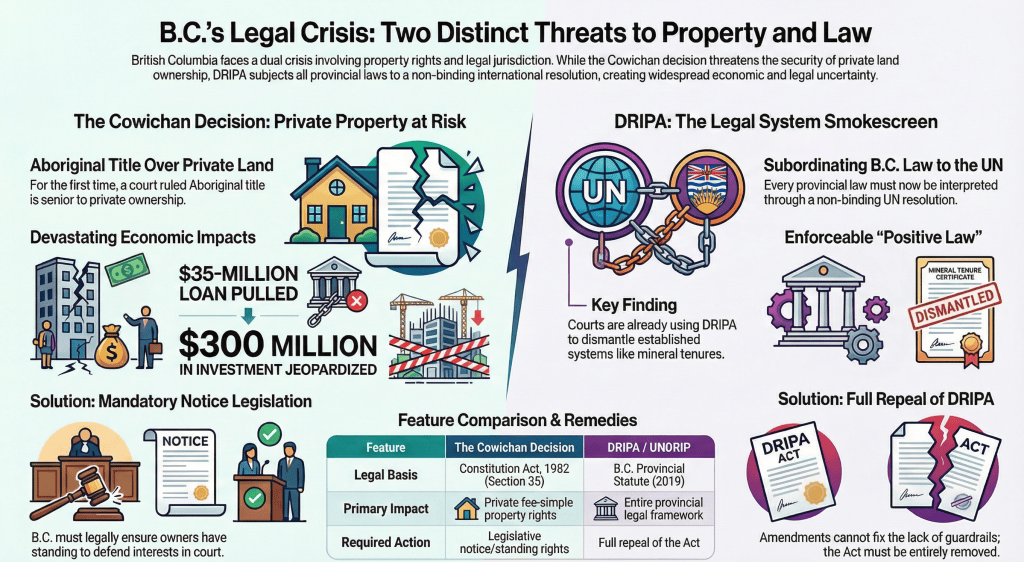
Good Wednesday morning beloved sentients. Today we examine DRIPA–the issue that determined the outcome of the recent British Columbia provincial election.
There’s nothing as powerful as fear to motivate an electorate. Politicians have known this since the beginning of democracy in ancient Greece. And, other than death, there’s no more fearful situation than the fear of imminent loss of land. This was the fear that the majority of voters in BC were under that caused them to vote Conservative in the recent election.
I did not vote for the Conservatives, I voted NDP in my Coquitlam riding. But then I do not own land that would be affected by the DRIPA empowerment of indigenous peoples over the land.
For most of its recent history, BC has been caught up in land disputes large and small. The lands of British Columbia–for geographic as well as geopolitical reasons, are among the most sought after in North America. BC’s relatively temperate/benign climate, as well as its verdant forests, have drawn migrants from all over the world, including myself.
I moved out to BC in 1967, coming out by train across Canada. As I looked at the BC scenery from the train window back in September of 1967 I was in awe of the greenery, particularly the fact that moss grew on the roofs of the houses! Coming from the bleak landscape of Sudbury, Ontario–ravaged as it was by the acid emitting from the nickel mines [where my father had worked for 18 years]…where all around was bare jagged rock of the Laurentian shield, you can imagine my shock!
But, I digress. Over the decades since I moved to BC there have been many scandals regarding the misuse or loss of valuable land to outsiders. Remember how BC’s provincial railway was sold off and eventually dismantled–mainly for the land the railway beds were on? This loss of AFFORDABLE mass public transportation was a loss our province has never recovered from.
Remember the fights between environmentalists/indigenous against logging companies over pristine forests of first growth timber? There’s a very long history of such disputes.
This relentless tug of war over land in BC has now morphed into the dispute about DRIPA. Please read the information posted below and at the links and I will have more comments to follow:
*********
B.C. First Nations chief warns ripping up DRIPA is a ‘declaration of war’ | Globalnews.ca
“The newly-elected B.C. Conservative government says B.C.’s Declaration on the Rights of Indigenous Peoples Act must be repealed.
However, the Union of B.C. Indian Chiefs warns against ripping up the agreement and instead urges using it as a framework for reconciliation.
On the campaign trail, the BC Conservatives have repeatedly said that repealing B.C.’s Declaration on the Rights of Indigenous Peoples Act (DRIPA) was a top priority.
Now that they are forming a majority government, First Nations are warning that it can’t happen.
“We’re not going to stand idly by while the government-elect does, in fact, rip it up,” Grand Chief Stewart Phillip, president of the Union of British Columbia Indian Chiefs said..”
WTF is this all about? BC is being destroyed.
*********
Greencrow comments: This is not just about docks anymore its about who owns BC and who gets to make decisions about the use of the land. It’s not a Pender Harbour problem its a province-wide problem and could soon be a national problem!
Hey, is this why [now former] BC Premier David Eby called the election…apparently he wanted to get a working majority– before the opposition to DRIPA became too powerful…IMO, he was too late. Eby lost the election spectacularly and a huge majority was given to the Conservatives under new Premier Lorne Doerkson.
Eby found out the hard way that Pandora’s Box was already opened.
**********
BELOW IS THE TEXT DESCRIPTION OF THE ABOVE VIDEO ABOUT THE DRIPA DISPUTE OVER PENDER ISLAND.
“PHARA.ca
November 2027 trial date
Oct 5, 2026 #29 hypedThis is a DRIPA battle, fought from the docks of Pender Harbour. The New Westminster Times editor David Brett talks with Sean McAllister and Suzanne Yuile of PHARA — the Pender Harbour and Area Residents Association — about the lawsuit that asks whether DRIPA is unconstitutional. What began as a fight over docks has become a residents’ fight-back against provincial law. In 2015 the government, after talks with the Sechelt Nation, brought in a dock management plan residents called unworkable. After DRIPA passed in 2019, Victoria moved toward a Section 7 agreement that would have given the Nation joint decision-making, and in residents’ view a veto, over dock authorizations. PHARA sued around 2021–22, before the Cowichan ruling made private-property uncertainty a province-wide story. Before the 2024 election the government withdrew that dock order-in-council. McAllister says a later foundation-agreement addendum kept other Section 7 talks alive and opened negotiations on Aboriginal title. A case-management conference has left a November 2027 trial date in place, with a chance the hearing could come sooner. The BC Cattlemen’s Association has said it will seek to intervene. As independent media, the New Westminster Times continues its consistent, timely reporting on this DRIPA battle. What You’ll Learn:
- How Pender Harbour residents turned a dock dispute into a DRIPA battle.
- What Section 7 agreements would have meant for decisions on the water.
- Why PHARA says it fought back in court before Cowichan, not after.
- What the withdrawn dock order-in-council did and did not settle.
- The November 2027 trial date and the next case-management step.
- Why the group says secret, piecemeal reconciliation is a province-wide fight.
Chapter Details / Timestamps: 00:00 – On the water at Pender Harbour with Sean McAllister. 00:16 – What PHARA is, and who is fighting back. 01:10 – From the 2015 dock plan to the DRIPA battle. 02:08 – Section 7 agreements and the decision to sue. 03:33 – The dock order-in-council withdrawn before the 2024 election. 03:49 – The foundation addendum, further Section 7 talks, and Aboriginal title. 05:20 – Why residents say DRIPA is unconstitutional and unnecessary. 07:30 – Early into the fight, years before Cowichan. 09:56 – Community reaction and the case-management update. 10:46 – Cattlemen’s Association as a possible intervener. 12:05 – How to support the fight: phara.ca. 13:27 – Land certainty, investment, and the election. 15:28 – Suzanne Yuile on why she joined the fight-back. 19:05 – Media, public awareness, and what a win would mean. Useful Resources: PHARA and donations: https://phara.ca New Westminster Times coverage of the DRIPA battle, Cowichan, Kamloops, and Gitsala: https://www.newwesttimes.com/ DRIPA (Declaration on the Rights of Indigenous Peoples Act) and Section 7 agreements: Government of British Columbia Stay Connected:
- Website and free newsletter: https://www.newwesttimes.com/
- Donate by credit card: on the homepage, click Support Our Work
- YouTube — subscribe and comment (we read every comment): – –
 / @thenewwestminstertimes4247
- On X — like and follow: https://x.com/NewWestTimes (@NewWestTimes)
- Write a letter to the editor for publication: editor@newwesttimes.com
The DRIPA battle in Pender Harbour is a residents’ fight-back: a test of whether a provincial statute can hand decision-making power to bodies they did not elect. PHARA was in court on DRIPA before Cowichan made the stakes obvious. The New Westminster Times will keep reporting this fight for British Columbians, Canadians, and First Nations members who want the terms in public. Should DRIPA be amended, withdrawn, or left for the courts? Tell us in the comments. Relevant Hashtags: #DRIPABattle#PenderHarbour#ResidentsFightBack#PHARA#DRIPA#Section7#Sechelt#shishalh#CowichanDecision#KamloopsGraves#Gitsala#UNDRIP#PropertyRightsBC#SunshineCoast#NewWestminsterTimes#DavidBrett#IndependentJournalism#BritishColumbia“
**********
********
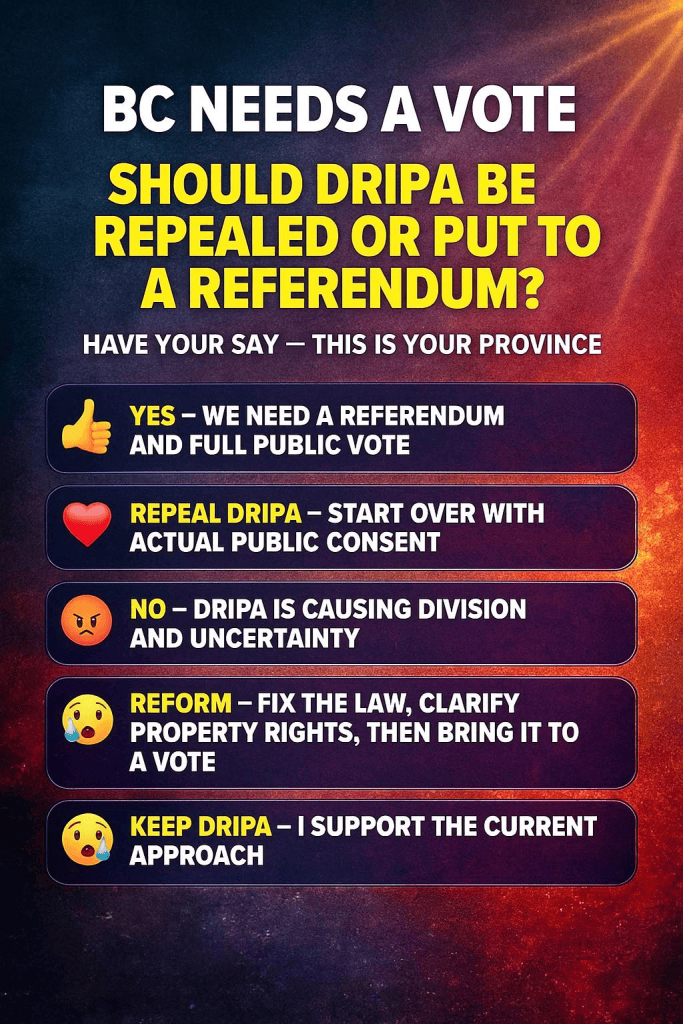
Greencrow concludes: The poster above was posted some months ago on a BC group’s Facebook website designed to oppose DRIPA.
Property rights must be clear and unalienable. People will NOT invest in a province where they are unsure whether the title to their land is good or not–where some group can come and just take their land–based on an international dogma.
And I notice that, just the other day, Manitoba Premier Web Kinew dragged out the old political Boogy Man, abolishing/repealing or amending The Indian Act.
There are many Canadian politicians who have ruined their careers touching the Canadian Tar Baby of The Indian Act. Looks like Kinew wants to be another one. And Mark Carney better not even think about joining Kinew in his self-immolation.
The Canadian Federal Indian Act of 1876 is like the original copy of a great grandfather’s will–in which he bequeathed fabulously rich property rights to his children and grandchildren. The Act has the original signatures–It is authentic and cannot be disputed.
Now, descendants can make photocopies of the Will and write amendments and revisions all over the copies to their heart’s content–BUT DO NOT TOUCH THE ORIGINAL DOCUMENT! OTHERWISE IN THE FUTURE thieves and robbers might say it does not exist.
THAT, folks, is why you do NOT touch The Indian Act and anyone who even suggests such a thing is a fool or a mendicant.
The Canadian Parliament can give all the rights and restitutions it wants to our first nations—and I do agree with giving them clean, healthy water to drink–as Carney is now moving forward on–but do not touch the Indian Act–do not even change its name to something less inaccurate or racist. It is what it is--it is an agreement between Queen Victoria and the “Indians” of Canada giving them inalienable rights.
Enshrine it in a museum where it belongs. Work on modern collaboration in new legislation based on current realities but DO NOT TOUCH THE INDIAN ACT.
With regard to DRIPA. I think indigenous people of BC should be smart enough to know that any UN legislation which denies certainty to British Columbians vis-a-vis the ownership/use of their land is something that will ultimately destroy the great Province of British Columbia. NOBODY will benefit from that. Even though I did not vote Conservative I understand and agree with the majority who did.
We need to find a working compromise re DRIPA and move on.
Stay tuned.


